How Yarn Doubling Machine Solves Issues for Cotton, Polyester, and Tencel in Blended Yarn Production
2025-12-12
When producing blended yarns, you’ve probably run into similar frustrations: cotton is soft and skin-friendly, but it breaks easily when spun alone; polyester is strong and durable, yet hard to blend evenly with cotton; Tencel feels smooth and offers excellent moisture absorption, but it’s prone to fuzzing if handled improperly. These materials are like "partners with different temperaments"—to get them to "cooperate" well into high-quality blended yarn, what you often lack is a yarn doubling machine that can resolve these "compatibility issues".
You might think a yarn doubling machine is just for combining a few yarns together, but in blended yarn production, its role goes far beyond "simple merging". Especially when dealing with three common fibers—cotton, polyester, and Tencel—that have significant differences in properties, a good yarn doubling machine acts like a "precise coordinator": it adapts to the needs of each material while helping them complement each other to deliver better overall performance. Next, let’s explore how a yarn doubling machine addresses the compatibility challenges of these three materials step by step, helping you improve both the efficiency and quality of your blended yarn production.
First, Understand: Why the "Property Differences" of Cotton, Polyester, and Tencel Create the "First Hurdle" in Blending
Before using a yarn doubling machine, you need to grasp the "unique traits" of cotton, polyester, and Tencel—these differences are what make blending challenging from the start.
Cotton: Skin-Friendly but "Delicate", Prone to Breaking and Unevenness During Spinning
You’re well aware of cotton’s advantages: it’s soft, moisture-absorbent, and comfortable against the skin, making it a "regular" in blended yarns. However, its drawbacks are equally obvious: its strength is relatively low, and it breaks easily if tension isn’t controlled properly during spinning. Additionally, cotton fibers vary slightly in length and thickness, so blending them directly with other materials often results in uneven yarn thickness, leading to defects in subsequent weaving.
You’ve likely noticed that even spinning pure cotton yarn requires extra care with tension—let alone blending it with other materials. Without pre-treatment by a yarn doubling machine, cotton fibers tend to "hold back" when combined with polyester or Tencel: either breaking and disrupting efficiency, or compromising the handfeel of the final blended yarn.
Polyester: Strong but "Stubborn", Hard to Bond with Other Materials
Polyester’s strengths perfectly complement cotton: it’s strong, resistant to stretching and deformation, and durable against washing and sunlight. Adding it to blended yarns boosts fabric durability. Yet its "stubbornness" is frustrating: its smooth surface means poor adhesion to fibers like cotton and Tencel.
You’ve probably encountered this scenario: blending polyester directly with cotton (without a yarn doubling machine) causes the two fibers to "separate" easily in the yarn, resulting in loose yarn structure and uneven dyeing later—areas with more polyester and areas with more cotton end up with different color depths. Moreover, polyester has greater elasticity than cotton and Tencel; poor tension control leads to uneven yarn tightness, affecting fabric flatness.
Tencel: Smooth but "Sensitive", Prone to Friction and Fuzzing
Tencel has grown popular in recent years for its silk-like smoothness and better moisture absorption than cotton. Adding it to blended yarns elevates fabric quality, but its "sensitivity" demands extra care during production: Tencel fibers have a fragile surface that easily fuzzes when rubbed. Additionally, their wet strength is lower than dry strength—excessive tension in doubling or poor humidity control in the production environment can cause breakage.
When producing Tencel blended yarns, you’ve likely experienced this: if the yarn doubling machine’s roller speed is too high or the yarn guides aren’t smooth enough, Tencel fibers fuzz heavily, leaving the final fabric dull and lusterless. Poor tension control increases breakage, wasting raw materials and reducing efficiency. These issues all require the yarn doubling machine to provide "adaptive" solutions.
Core Capabilities of a Yarn Doubling Machine: Targeted Solutions for Three Materials’ Compatibility
Once you understand the "property challenges" of cotton, polyester, and Tencel, you’ll see that a yarn doubling machine in blended yarn production doesn’t just "merge yarns uniformly"—it provides "customized" treatments for each material. Its core capabilities lie in tension control, yarn guide systems, and roller speed adjustment—turning the "incompatibility" of the three materials into "complementary strengths".
Precise Tension Control: Preventing Cotton Breakage, Polyester Looseness, and Tencel Fuzzing
Tension is the "lifeline" of yarn doubling for blended yarns: too little tension leads to loose, poorly bonded yarns; too much tension causes cotton breakage, Tencel fuzzing, and polyester deformation. A high-quality yarn doubling machine adjusts tension to the "sweet spot" based on the properties of the three materials.
For cotton fibers, the machine’s tension needs to be "gentle": tight enough to avoid loose cotton yarns, but not so tight that fibers break. During operation, you’ll notice that the tension system for cotton uses sensors to monitor yarn tightness in real time. If tension becomes too high, it automatically fine-tunes to prevent breakage while maintaining enough tension to ensure cotton bonds tightly with subsequent polyester or Tencel.
For polyester, tension needs to be "moderately tight": its smooth surface means slightly loose tension will cause it to "separate" from other fibers. Thus, the yarn doubling machine maintains sufficient tension to keep polyester "wrapping" around cotton or Tencel, enhancing yarn structural stability. However, tension can’t be too high—overstretching polyester reduces its elasticity, leading to fabric shrinkage after washing. The machine’s tension system precisely controls it within a range that "ensures adhesion without deformation".
For Tencel, tension needs to be "even gentler": Tencel fibers are fragile, so excessive tension causes breakage and fuzzing. The machine’s tension adjustment for Tencel is softer than for cotton, and some models even include a humidity control system to maintain Tencel’s moisture levels, boosting its strength and reducing fuzzing. When producing Tencel blended yarns, simply switching the machine to "Tencel mode" will noticeably reduce fuzzing and breakage.
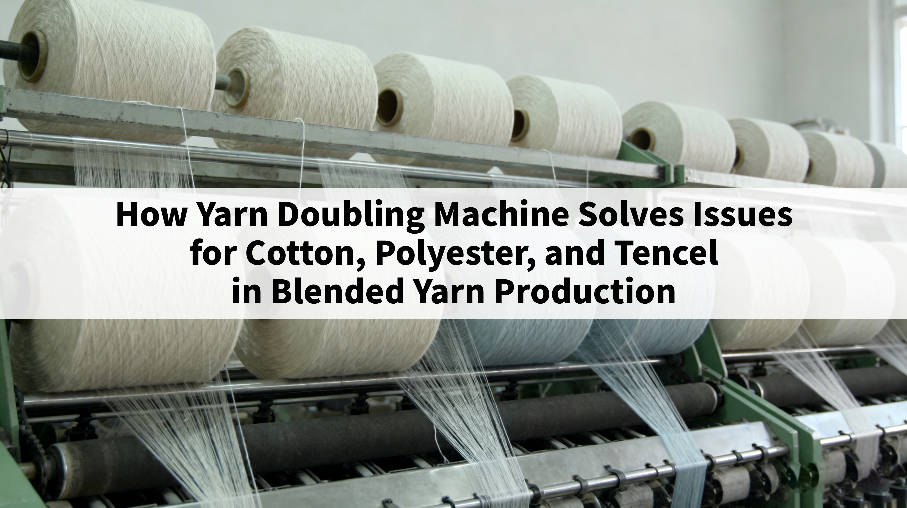
Smooth Yarn Guide System: Reducing Friction to Protect Tencel and Bond Cotton/Polyester
The yarn guide system is the part of the doubling machine that "contacts yarns most frequently". If the yarn guides are rough or poorly angled, yarns will rub against them—causing Tencel to fuzz, cotton to break, and polyester to become rough (compromising adhesion).
High-quality yarn doubling machines feature "specially treated" yarn guide systems: components like yarn guide hooks and rods are made of smooth ceramic, minimizing friction with yarns. A quick touch will confirm that ceramic guides are far smoother than ordinary metal ones, allowing yarns to pass with almost no resistance. Additionally, the angle of the guides is adjusted based on the three materials’ properties: Tencel uses a gentler guide angle to avoid fiber stretching, while cotton and polyester use a slightly steeper angle to ensure tight merging without frictional damage.
You might not have noticed, but the "stability" of the yarn guide system is also critical. Slight wobbling of the guides causes yarns to shift left and right, increasing friction. Premium machines secure the yarn guide system firmly and use synchronized transmission devices to keep yarns moving along a fixed path, reducing friction-related damage.
Adjustable Roller Speed: Adapting to the "Spinning Rhythm" of Different Materials
Rollers are the components that drive yarns forward in the doubling machine, and their speed directly impacts spinning efficiency and quality. Cotton, polyester, and Tencel have different "spinning rhythms": cotton fibers (medium length) break easily at high roller speeds; polyester (high strength) tolerates faster speeds; Tencel (fragile) requires slower speeds to avoid overstretching.
The yarn doubling machine’s adjustable roller speed function lets you adapt to these material-specific needs. When producing cotton blended yarns, you can slow the rollers down to give cotton fibers more time to bond with other fibers, reducing breakage. For polyester blended yarns, you can increase speed slightly to boost efficiency (thanks to polyester’s strength). For Tencel blended yarns, slowing the rollers again—paired with gentle tension—protects Tencel from breakage and minimizes fuzzing.
Moreover, top-tier machines offer "multi-stage speed adjustment": slower speeds when yarns first enter the machine to stabilize them, speed adjustments based on material properties during merging, and fine-tuning during winding to ensure tight, even yarn packages. This "segmented adjustment" keeps all three materials in optimal condition throughout the doubling process, avoiding quality issues caused by improper speed.
Practical Value of a Yarn Doubling Machine: Beyond Compatibility, Cutting Costs and Boosting Efficiency
You might wonder: is it worth investing in a yarn doubling machine that works with cotton, polyester, and Tencel? Beyond solving compatibility issues and improving blended yarn quality, it delivers tangible "cost-saving and efficiency-boosting" benefits—directly impacting your production efficiency and profit margins.
Reducing Raw Material Waste: Fewer Breaks, Less Fuzz, and More Efficient Material Use
Raw material waste is a common cost drain in blended yarn production: broken yarns lead to scrap, and excessive fuzz increases defective yarns—both raising material costs. A yarn doubling machine adapted to cotton, polyester, and Tencel drastically reduces breakage and fuzzing through precise tension control, smooth yarn guides, and adjustable roller speeds.
Let’s do the math: if your Tencel blended yarn production previously had a 5% breakage rate and 8% fuzz-related defect rate, a suitable doubling machine could lower these to 2% and 3% respectively. For every ton of blended yarn produced, this reduces waste by (5% + 8% - 2% - 3%) = 8%. At a Tencel cost of $3,000 per ton, this saves $240 per ton—adding up to $24,000 annually for a 100-ton production volume (and this doesn’t include savings from cotton-polyester blends).
Fewer breaks also reduce "splicing" work. You know that broken yarns require manual splicing, which is time-consuming and can create uneven splices that harm yarn quality. With fewer breaks, workers spend less time splicing and more time on other production tasks—indirectly boosting efficiency.
Boosting Production Efficiency: Fewer Downtimes, Stable Output, and Higher Yields
Production efficiency largely depends on "downtime frequency" and "equipment stability". Frequent halts to fix breakage or fuzzing cut into daily production time; stable equipment that consistently produces qualified yarns naturally boosts output.
A yarn doubling machine adapted to cotton, polyester, and Tencel significantly reduces downtime by addressing material-specific issues. For example, when producing cotton-polyester blends, you might have previously stopped the machine hourly to adjust tension (due to poor adhesion). With the right machine, the tension system adapts automatically, requiring only 1-2 daily checks. For Tencel blends, smooth yarn guides reduce fuzzing, cutting down on the need to stop and clean guides.
Fewer downtimes extend the machine’s "effective production time". Suppose your equipment previously ran for 16 effective hours a day—this could increase to 20 hours with a quality doubling machine. At a production rate of 50 kg per hour, this adds 200 kg of daily output—translating to substantial annual gains. Stable equipment also eases worker operations: fewer 故障 mean workers can oversee more machines, further improving overall efficiency.
Ensuring Consistent Quality: Uniform Blended Yarns and Higher Customer Satisfaction
For blended yarn production, "consistent quality" matters more than "occasional high-quality batches". If a batch contains uneven yarns, fuzzy sections, or inconsistent thickness, customers are likely to return orders—harming both your revenue and reputation. A yarn doubling machine ensures consistent quality across every batch through precise control of tension, speed, and yarn guiding.
You’ve probably experienced this: with an ill-suited machine, cotton-polyester blended yarns often have uneven fiber distribution, leading to patchy dyeing and customer rejections. With an adapted machine, yarn uniformity improves dramatically—dyeing becomes consistent, and returns drop. For Tencel blends, reduced fuzzing enhances fabric smoothness and luster, making customers willing to pay a premium—this is the "price advantage" of consistent quality.
Consistent quality also cuts "rework costs". Defective yarns require re-spinning and re-dyeing, wasting materials and delaying deliveries. A doubling machine eliminates most defects, reducing rework, ensuring on-time deliveries, and building long-term customer trust—ultimately increasing order volumes.
Finally: Choose the Right Yarn Doubling Machine for Hassle-Free Cotton, Polyester, and Tencel Blending
In blended yarn production, the challenge often isn’t the materials themselves—it’s choosing equipment that solves "compatibility issues". Cotton’s delicacy, polyester’s stubbornness, and Tencel’s sensitivity can all become strengths with the right yarn doubling machine: combining cotton’s softness, polyester’s strength, and Tencel’s smoothness into high-quality blended yarns.
You’ll no longer struggle with breakage, fuzzing, or unevenness; you won’t need to constantly adjust machine settings; and you’ll avoid the risks of material waste and customer returns. A yarn doubling machine adapted to cotton, polyester, and Tencel turns production "headaches" into "smooth sailing", letting you focus on expanding your market and increasing orders—instead of being held back by equipment or quality issues.
So next time you evaluate blended yarn production equipment, pay close attention to the yarn doubling machine’s tension control, yarn guide system, and roller speed adjustment capabilities. Choose the right "coordinator", and blending cotton, polyester, and Tencel will be far easier than you think—making your production more efficient and profitable.