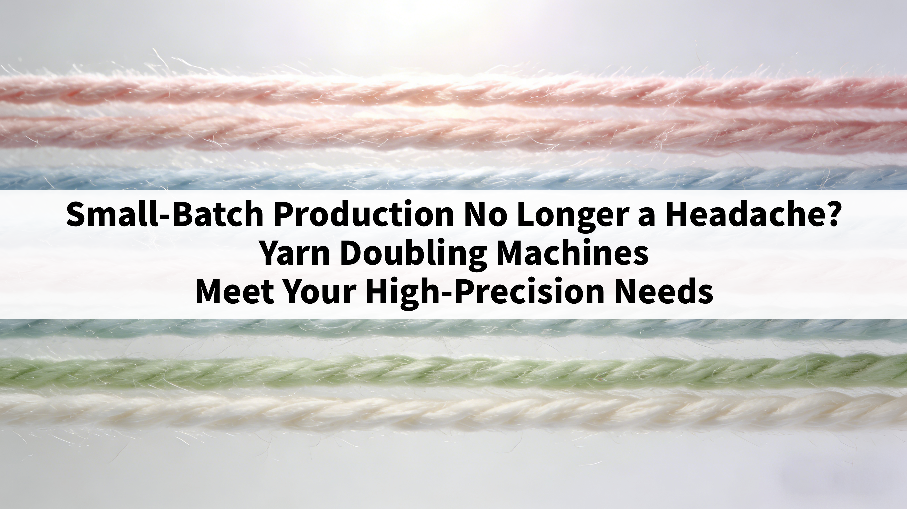
Small-Batch Production No Longer a Headache? Yarn Doubling Machines Meet Your High-Precision Needs
2026-01-04
After years in textile processing, you’ve likely felt the market shift: large-volume orders are no longer the norm. Instead, demand for small-batch, multi-specification products is growing rapidly. At the same time, customer requirements for yarn quality haven’t diminished—if anything, standards for details like thickness uniformity and twist stability are becoming stricter. This is when you’ll find that the standard yarn doubling machines you once relied on are struggling to keep up: adjusting parameters takes hours, loss rates for small-batch production remain high, and meeting high-precision requirements for special specifications feels nearly impossible. The rising demand for custom yarn doubling machines stems precisely from their ability to address these two core pain points—small-batch production and high precision—making them your key ally in adapting to market changes.
Why Standard Yarn Doubling Machines Fall Short in the Age of Normalized Small-Batch Production
In today’s textile market, "production based on sales" is increasingly common, and customer needs are becoming more segmented. You might receive orders for hundreds of meters of specialty yarn or small-batch trial orders for multiple specifications—order fragmentation has become the new normal. In this context, the limitations of standard yarn doubling machines are becoming more apparent, while the advantages of custom equipment are coming to the fore.
Production Pain Points Amidst Order Fragmentation
You’ve certainly had this experience: just after tuning a standard yarn doubling machine for one small order, the next order requires a different yarn count or ply number. Re-adjusting the equipment not only takes significant time to fine-tune tension and twist but also generates a lot of waste during debugging. Sometimes, an order is only a few hundred kilograms, but the standard machine’s minimum production batch doesn’t match, leading to serious raw material waste. What’s more, some special-specification yarns fall outside the parameter range of standard machines—you either have to turn down the order or produce subpar products that fail to meet customer requirements, damaging your reputation. These pain points essentially stem from the conflict between the "one-size-fits-all" design of standard machines and the "personalized" needs of fragmented orders.
Adaptability Limitations of Standard Machines
Standard yarn doubling machines are designed to meet the needs of large-volume, fixed-specification production. Their parameter adjustment range is limited, and their structure is relatively fixed. For example, many standard machines can only adjust between 2-4 plies, but small-batch orders may require special requirements like 1-ply twisting or 5-ply doubling. In terms of tension control, standard machines have a wide tension range, making it impossible to achieve the high-precision tension control needed for fine yarns or specialty fiber yarns. Additionally, standard machines have cumbersome thread-changing processes. Frequent thread changes for small-batch orders severely impact production efficiency and drive up unit production costs—problems you can’t avoid in actual production.
The Flexible Adaptation Logic of Custom Machines
The core advantage of custom yarn doubling machines lies in "on-demand adaptation." They don’t constrain your production with uniform standards but instead optimize design based on the characteristics of your small-batch orders. For example, to address frequent specification changes, custom equipment expands the parameter adjustment range—from ply count to twist and tension, all can be adjusted quickly. Thread changes no longer require major overhauls; switching to new production parameters takes just a few minutes. To reduce waste in small-batch production, custom equipment optimizes feeding and yarn guide structures, minimizing scrap during debugging and enabling efficient production even for orders as small as tens of kilograms. This "tailor-made" logic directly addresses the production pain points of the order fragmentation era.
High Precision Becomes a Hard Requirement—How Custom Yarn Doubling Machines Achieve Precise Matching
As market competition intensifies, customer requirements for yarn quality are becoming increasingly stringent: not only must yarn be uniform in thickness and low in hairiness, but it must also have stable twist and consistent strength. These high-precision requirements have become key indicators of product competitiveness. Custom yarn doubling machines meet these demands by conducting targeted technical optimizations around your precision needs, rather than "spreading resources evenly" like standard machines.
Strict Industry Requirements for Yarn Quality
You know that "good enough" no longer cuts it in today’s yarn market. For example, yarn used in high-end fabrics may be rejected by customers if the thickness deviation exceeds 0.5%. For yarn used in special applications, uneven twist can cause color differences after dyeing, directly reducing the value of the final product. Customers demand such high precision because these details directly determine the effectiveness of subsequent weaving and dyeing processes, as well as the durability and aesthetics of the final product. For you, meeting these high-precision requirements is not only crucial for retaining customers but also an important way to increase product premium—something standard yarn doubling machines struggle to achieve.
Core Precision Control of Custom Equipment
The high precision of custom yarn doubling machines doesn’t come from stacking complex scientific research technologies but from a design philosophy of "precise adaptation." First, based on the types of yarn you commonly process (such as fine yarns or specialty fiber yarns), it optimizes the tension control system, adopting more precise sensors and adjustment mechanisms to ensure consistent tension across every ply of yarn, avoiding uneven thickness caused by tension fluctuations. Second, in terms of twist control, custom equipment refines twist adjustment gears, supporting more narrow-range precision settings to keep twist deviation within a minimal range. Additionally, for details like hairiness control and doubling uniformity, custom equipment adjusts the design of yarn guides and doubling mechanisms based on your specific needs, reducing fiber slippage and hairiness. These optimizations may seem simple, but they directly solve your practical challenges in high-precision production.
Practical Production Value of High Precision
For you, the high precision of custom yarn doubling machines brings not only quality improvements but also tangible production benefits. On one hand, high-precision yarn reduces waste in subsequent processes—for example, lower yarn breakage rates during weaving and fewer color differences during dyeing—eliminating the need to invest additional labor and raw materials to compensate for quality defects. On the other hand, high-quality yarn helps you enter the high-end market: the same order can be sold at a higher price if the yarn meets precision standards, increasing product profit margins. More importantly, stable high-precision quality helps you build a reputation, making customers feel "reliable when working with you for small-batch, high-precision orders," thereby attracting more repeat customers and referrals, forming a virtuous cycle.
Core Adaptation Points of Custom Yarn Doubling Machines: Seamless Connection from Small-Batch to High-Precision
Custom yarn doubling machines have become the preferred choice under the small-batch, high-precision trend because they achieve "seamless adaptation" in multiple dimensions—solving the flexibility issues of small-batch production, meeting high-precision quality requirements, and adapting to your existing production processes without adding extra operational burden.
Flexibility of Parameter Adjustment Range
The core pain point of small-batch production is "frequent specification changes," so custom yarn doubling machines expand the parameter adjustment range accordingly. For example, in terms of ply count, custom equipment can support free switching between 2-8 plies or more—whether you’re producing 2-ply or multi-ply doubled yarn, you can achieve it by directly adjusting parameters without replacing core components. The twist adjustment range is also wider, from low twist to high twist, accurately matching the style needs of different fabrics. Tension control is divided into multiple gears, allowing you to find the right tension parameters for yarns of different thicknesses and materials. This flexible parameter adjustment capability enables you to handle various small-batch orders with ease, no longer having to turn down orders due to mismatched specifications.
Equipment Compatibility Design
You may worry that custom equipment won’t be compatible with your existing production line. In fact, custom yarn doubling machines fully consider this during design. They optimize the equipment’s interfaces, dimensions, and operational logic based on your existing production processes—for example, achieving seamless connection with upstream spinning machines and downstream winding machines without the need for additional production line modifications. The equipment’s operation interface maintains the same logic as your existing equipment, allowing workers to get started without re-training, reducing training costs. Additionally, custom equipment supports multiple feeding methods and discharge specifications, adapting to your existing packaging and transportation processes without disrupting your production rhythm. This compatibility design allows you to integrate custom equipment quickly without incurring additional adaptation costs.
Operation Adapted to Small-Batch Production Rhythms
The rhythm of small-batch production differs from large-volume production—frequent order changes and debugging are the norm. The operational design of custom yarn doubling machines is fully adapted to this rhythm. For example, the equipment is equipped with a parameter storage function: you can save parameters for several commonly used order specifications and call them with one click when changing orders, eliminating the need for re-debugging and significantly saving order change time. The operation interface is simpler and more intuitive, with core parameters clearly displayed, allowing workers to complete adjustments quickly and reduce operational errors. Additionally, the equipment adds a fault warning function—prompting in a timely manner when tension is abnormal or twist deviates—avoiding mass production of defective products in small-batch production and reducing waste. These operational optimizations allow you to maintain efficient operation even in small-batch production, without reducing productivity due to frequent order changes.
Choosing a Custom Yarn Doubling Machine: Avoid Misunderstandings and Grasp Core Value
Faced with the growing demand for custom yarn doubling machines, many people fall into misunderstandings when choosing—such as pursuing "the more functions, the better" or "the more comprehensive parameters, the better"—while ignoring their actual needs. In fact, the core of choosing custom equipment is "adaptation." By focusing on key points, you can select equipment that truly suits you and avoid wasting costs.
Don’t Pursue "Full Functions"—Prioritize Adaptability
The core of customization is "on-demand customization," not "full-function stacking." When choosing, you first need to clarify your core needs: for example, what specifications of yarn do you mainly produce? What is the approximate batch range? Where are your precision requirements concentrated? Choose equipment based on these core needs, rather than blindly pursuing "ability to produce all specifications" or "having all functions." For example, if you mainly produce 2-4 ply small-batch doubled yarn, there’s no need to choose equipment that supports more than 8 plies—this will only increase procurement costs. If you have high requirements for twist precision, focus on the precision parameters of twist control rather than getting bogged down in irrelevant functions. Choosing equipment that best fits your production needs ensures maximum cost-effectiveness.
Precision Parameters Must Be Practical—Don’t Be Misled by Gimmicks
Many equipment manufacturers promote "ultra-high precision" or "extreme control," but these claims need to be translated into specific verifiable parameters. When choosing, pay attention to actual measurable precision indicators: for example, what is the tension control precision? What is the twist deviation range? What is the specific value of doubling uniformity? Don’t just rely on the manufacturer’s verbal promises. At the same time, evaluate precision parameters against your actual production needs—for example, if your yarn requires a twist deviation of no more than 1%, there’s no need to choose equipment with a deviation of 0.1%, as the latter will have a much higher procurement cost with limited additional benefits. Only by matching precision parameters to your actual needs can you avoid paying for unnecessary "ultra-high precision."
Focus on Usage Costs—Balance Flexibility and Economy
Choosing a custom yarn doubling machine shouldn’t rely solely on procurement price; long-term usage costs must also be considered. For example, equipment maintenance costs: are wearing parts easy to purchase? Is maintenance simple? Are replacement costs high? Another example is energy consumption costs: can the equipment operate efficiently at low loads for small-batch production? Will unit energy consumption be too high due to small batches? Additionally, consider the equipment’s service life and depreciation costs. Choose equipment with durable core components and stable structure—although the initial procurement cost may be slightly higher, it will be more cost-effective in the long run. Striking a balance between flexibility and economy allows custom yarn doubling machines to truly create value for you, rather than becoming a burden.
In essence, the small-batch, high-precision market trend is both a challenge and an opportunity for you. The challenge lies in the fact that traditional production equipment and models can no longer keep up; the opportunity is that whoever can first meet these needs will seize the initiative in the niche market. The value of custom yarn doubling machines doesn’t lie in advanced technology, but in their ability to accurately solve your practical difficulties under this trend: making small-batch production no longer inefficient and wasteful, making high-precision requirements no longer unattainable, and allowing you to stand firm in fierce market competition with "reliable small-batch production and stable high precision."
Choosing a custom yarn doubling machine that suits you is not following the trend, but a clear understanding of your production needs and accurate grasp of market trends. It won’t expand your production capacity overnight, but it will help you do better and more stably in the small-batch, high-precision niche, building an irreplaceable competitive advantage—this is the key to your sustained profitability in the current market environment.